The Rise and Influence of Generative AI on the Environment
This article was originally published in the March 2026 print edition of The Bark, distributed at the University of Minnesota Duluth campus.
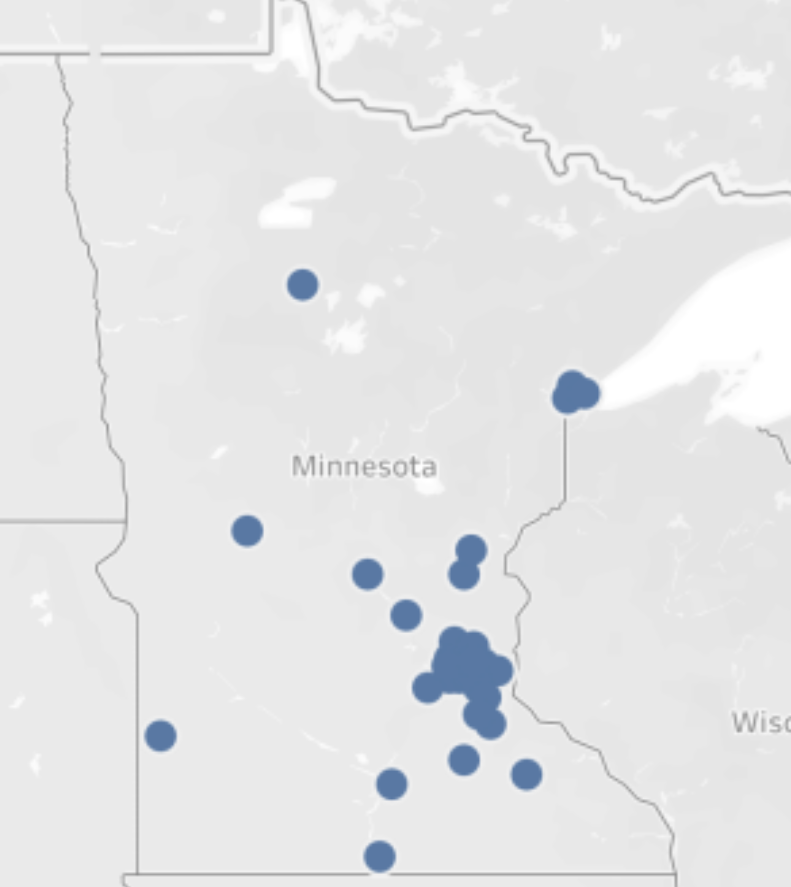
Data centers located in Minnesota. Map provided by Caleb Olson
The rise of AI over the past two years has become more noticeable in everyday life. From creating recipes to providing outlines for lesson plans, there are a variety of opportunities to use AI to decrease one’s workload. However, there is a downside to the use and development of AI regarding its influence on the environment. Studies show that there is a significant impact on the climate, energy and water – all resources that are essential to sustaining human life.
According to Microsoft, AI systems are structured around model training, which creates a high energy demand due to the learning nature of the AI as it processes and relays information to the user. When this is coupled with the growing national and global demand for generative AI, the data centers, which manage and sustain the AI operating systems, must run constantly, which can contribute to environmental impacts.
A local issue is the ongoing conversation and development of the Hermantown data center project, which will create changes for the surrounding communities regarding water and energy usage. The data center, like most data centers, will likely introduce new impacts on the power grids in the area, as there will be more strain on the supply and demand of electricity, as well as new strain on the wetlands and natural areas on which it would be built.
Another regional concern for the communities of Duluth and Hermantown, provided by the Stop the Hermantown Data Center organization, is the use of water, particularly with the presence of Lake Superior in close proximity to both areas. As data centers process information to support AI systems, the machinery also produces heat via thermal energy, which then requires a circulating water system to assist the facility in maintaining a cool operating temperature. The Stop the Hermantown Data Center organization is particularly concerned for the preservation of natural assets such as the watersheds in the area, which lead to the St. Louis Watershed and Lake Superior, as well as designated trout streams and rivers.
Furthermore, many people feel as though there is a lack of transparency and information when it comes to the impacts and influence of AI on the environment. According to an article written by Alex de Vries-Gao on Science Direct, the fact of the matter is that it is difficult to establish a clear estimate of the carbon and water footprints left by AI companies and operations.
Many articles are similar to this piece as writers voice their frustrations as well as conduct studies to fill in the data gaps left by AI companies. Most studies find that while there is an abundance of data to be found, some companies, such as Google, decline to report certain figures as they deem it not necessary. This creates a gap between what the companies know and what the public is allowed to know, which violates the Greenhouse Gas Protocol, which “...mandates disclosure of indirect emissions related to electricity consumption” (de Vries-Gao, 2026). This contributes to the lack of transparency and available information on the impact of AI on the environment.
Regarding the impact of AI on the climate, a separate study conducted by the University of Waterloo showed that emissions from AI will not be noticeable at a global level. In the associated article, Dr. Juan Moreno-Cruz, who is a professor in the Faculty of Environment at Waterloo, says, “If you look at that energy from the local perspective, that’s a big deal because some places could see double the amount of electricity output and emissions. But at a larger scale, AI’s use of energy won’t be noticeable” (University of Waterloo, 2025). It can be argued then that the impact of AI is a matter of relativity and perspective, while acknowledging the positives and negatives of AI when discussing the environment.
AI is making strides in becoming more and more a part of our everyday lives. While it can be a useful tool in helping with research, travel and work, it is essential to be aware of all sides of the story as there continue to be new developments in the technology.